
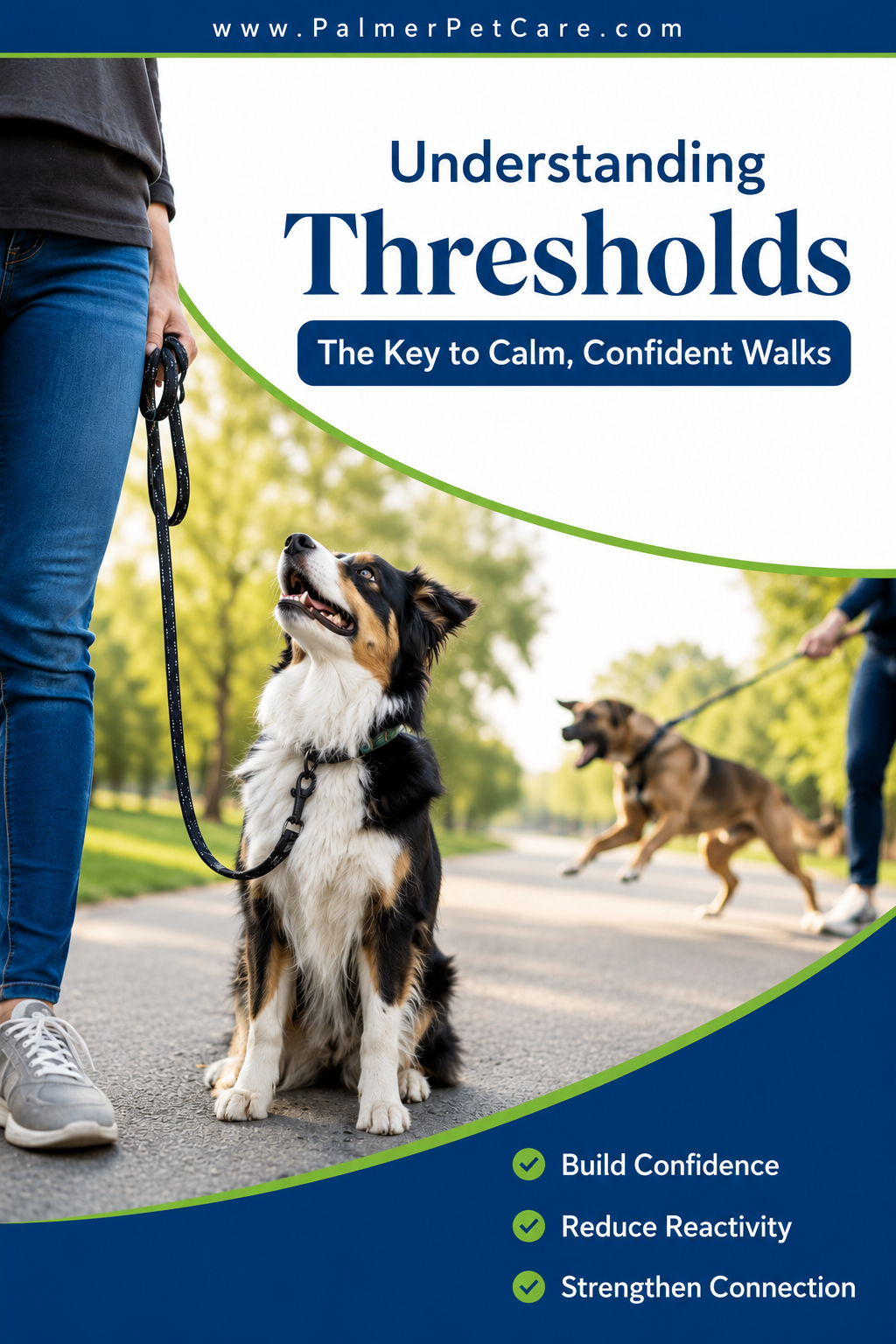

Have you ever heard the phrase “Training Threshold” and wondered what that even means?
Well, let’s say you’ve asked your dog to sit during a walk, only to have them completely ignore you because another dog walked by.
Or maybe they’ve become so focused on a squirrel, an interesting smell, or an exciting person that it’s as if you suddenly disappeared.
It isn’t stubbornness.
It isn’t disobedience.
Most of the time, your dog has simply crossed what’s known as their training threshold.
Understanding your dog’s training threshold is one of the most valuable skills you can learn as a pet parent, and it’s one of the core principles behind Fear Free® and positive reinforcement dog training.
Understanding Your Dog’s Training Threshold
A dog’s training threshold is the point where something in their environment becomes so exciting, scary, or distracting that they’re no longer able to think clearly or respond to cues they already know.
Every dog has a training threshold.
Some dogs become overwhelmed by another dog across the street. Others may struggle with bicycles, skateboards, joggers, wildlife, unfamiliar people, loud noises, or even an especially interesting patch of grass.
Once your dog crosses their training threshold, their brain shifts from learning mode into survival mode.
Instead of processing information and making thoughtful choices, they’re simply reacting to what’s happening around them.
That’s why asking for a sit—or any other cue—often feels impossible once your dog is beyond their training threshold.
Rather than viewing this as stubbornness or defiance, it’s more helpful to recognize that your dog simply isn’t in the right frame of mind to learn.
Why Fear Free Dog Training Works
At Palmer Pet Care, all of my training is built around Fear Free® and positive reinforcement principles.
Rather than forcing a dog through situations they find overwhelming, we carefully work below their training threshold, where they’re still able to think, learn, and make good decisions.
When dogs remain below their threshold, they’re much more likely to:
- Learn new behaviors
- Stay engaged with their handler
- Build confidence
- Develop positive associations with things that once felt scary or overwhelming
Instead of overwhelming a dog and hoping they “get used to it,” we gradually increase the challenge over time while celebrating small successes along the way.
Confidence is built one successful repetition at a time!
Try This Simple Exercise
Want to discover your dog’s current training threshold?
Try this simple exercise during your next walk.
The next time your dog notices something interesting—another dog, a squirrel, a person walking by, or even an irresistible smell—pause and ask for a simple sit.
If your dog immediately sits and looks back at you, they’re probably still below their threshold.
If they stare at the distraction, ignore your cue, or simply can’t disengage, don’t repeat yourself over and over.
Instead, calmly move about five feet farther away and ask again.
Still too distracted? Move another five feet.
Repeat this process until your dog is finally able to:
- Look away from the distraction
- Check in with you
- Respond to your cue by sitting
Congratulations! You’ve just discovered your dog’s approximate training threshold for that particular situation.
That distance becomes your starting point for future training sessions.
With patience, consistency, and positive reinforcement, you’ll often find that your dog’s training threshold gradually changes over time. As they build confidence and develop new skills, they’ll begin to be able to stay calm and engaged much closer to the same distraction than they could before.
Every Dog’s Training Threshold Is Different
One of the biggest misconceptions about dog training is believing that a dog’s training threshold is always the same.
It isn’t.
Your dog’s training threshold can change from day to day—or even minute to minute.
Factors that influence your dog’s training threshold include:
- Fatigue
- Excitement
- Stress
- Hunger
- Pain or illness
- The type of distraction
- The environment
- Previous experiences
A dog who can calmly watch another dog from twenty feet away in a quiet neighborhood might need sixty feet at a busy park. That’s completely normal.
Successful dog training isn’t about comparing your dog to someone else’s. It’s about recognizing where your dog’s training threshold is today and helping them succeed from there.
Training Safely
This exercise should always feel easy and enjoyable for your dog.
If you notice signs of stress—such as barking, lunging, whining, freezing, refusing treats, or becoming hyper-focused on the distraction—you’ve probably moved too close.
Simply create more distance and try again.
And remember, if you’re practicing during a Central Texas summer, safety always comes first.
Choose cooler parts of the day, bring fresh water, keep sessions short, and watch for signs of overheating. If you haven’t already, check out my article Summer Pet Heat Safety: Protecting Your Pets During the Texas Heat for additional tips on exercising safely in the Texas heat.
Need Help Understanding Your Dog’s Training Threshold?
Learning to recognize your dog’s training threshold can completely change the way you communicate together.
Whether your goal is reducing reactivity, improving loose-leash walking, or simply helping your dog become more confident, understanding when your dog is ready to learn is one of the biggest keys to success.
Every dog learns at their own pace, and every training plan should be tailored to the individual dog—not a one-size-fits-all approach.
If you’d like personalized guidance, I’d love to help. My private, one-on-one training sessions take place in your home, your neighborhood, or another location where your dog feels comfortable, allowing us to build confidence in real-world situations.